
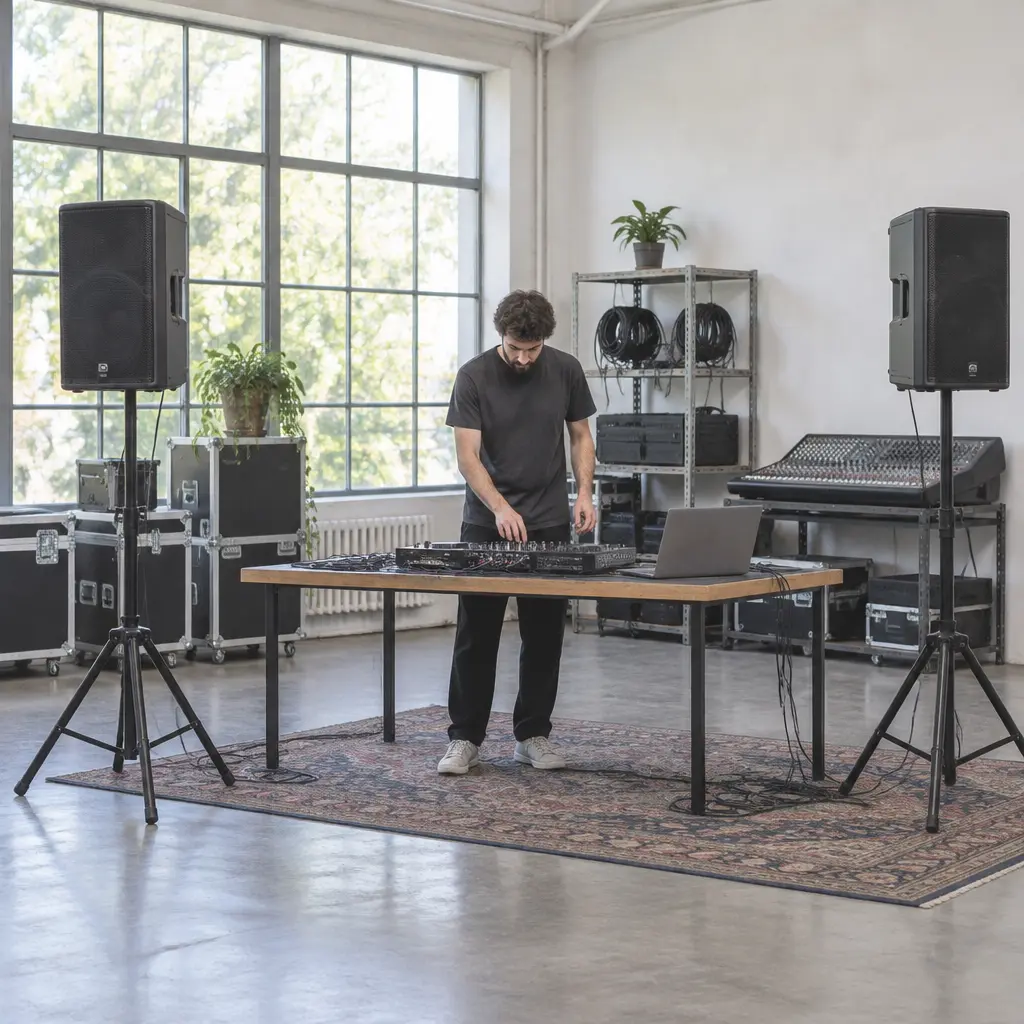
DJ equipment buying decisions are choices about what to purchase, rent, or postpone so a DJ can deliver reliable performances without taking on debt or tying up cash before bookings generate income. A budget-protective approach starts with the actual requirements of upcoming gigs, favors dependable essentials over speculative upgrades, and compares buying with renting and used gear. That matters in a market where equipment costs vary widely and a single failure can disrupt paid work: the U.S. Bureau of Labor Statistics reported a 2023 median annual wage of $37,970 for disc jockeys, while noting that earnings and work schedules vary. The sections below turn that financial reality into practical criteria for choosing core gear, managing risk, and deciding when an upgrade is justified.
DJ equipment buying decisions protect budgets through needs-based purchasing
A needs-based DJ equipment purchase is a buying decision tied to a defined performance requirement, an affordable total cost, and a realistic path to use. It is not simply the cheapest option: reliability, compatibility, transport, setup time, and backup plans all affect the real cost of owning gear. The U.S. Small Business Administration advises small businesses to account for startup costs and estimate when revenue may begin; the same discipline helps DJs avoid spending gig income before it arrives.
The main categories are essential equipment, conditional equipment, and optional upgrades. Essentials make the planned set possible; conditional items are needed only for particular venues or formats; optional upgrades improve convenience or presentation but may not yet earn back their cost. Separating purchases this way keeps a DJ from treating every attractive product as urgent.
Essential gear is defined by the gig’s technical requirements
Essential gear is the minimum dependable kit needed to perform the contracted job. For a controller-based setup, that may mean a compatible laptop, DJ controller, headphones, required cables, and access to the venue’s sound system. A mobile DJ may also need speakers, stands, a microphone, and power or signal accessories. The venue’s input list and the client’s service agreement—not a generic “complete setup”—should determine what belongs on the essential list.
Before buying, confirm connection types, software compatibility, output levels, and who supplies the PA. A venue-provided system can make speaker ownership unnecessary for a particular booking, while a self-contained event may make speakers indispensable. Written confirmation prevents a costly mismatch between equipment and the job.
Conditional and optional purchases depend on utilization
Conditional equipment solves a recurring but not universal need, such as a wireless microphone for weddings or a second controller for a specific performance format. Optional upgrades include cosmetic lighting, premium cases, or higher-end monitoring when existing equipment already meets the gig’s requirements. A useful test is expected utilization: estimate how many booked or highly probable gigs will use the item, then compare its ownership cost with rental cost over that same period.
For example, if a DJ needs an additional speaker system for one confirmed event, a local rental may cost less than buying, transporting, and maintaining a system that would otherwise sit unused. The calculation should include delivery, deposits, insurance, and setup—not just the advertised rental price.
Total cost of ownership clarifies DJ equipment buying decisions
Total cost of ownership is the full expected cost of acquiring and using equipment, rather than its sticker price alone. The U.S. Small Business Administration’s startup-cost guidance distinguishes one-time expenses from ongoing costs, a useful framework for DJ gear. Relevant costs can include sales tax, shipping, protective cases, cables, software subscriptions, repairs, replacement parts, insurance, and eventual resale value.
This measure connects purchase price to cash flow and break-even timing. A more expensive item may be economical if it is durable, frequently booked, and easy to service; a low-priced item may become costly if it needs repeated repairs or cannot meet client or venue requirements.
Break-even analysis tests whether a purchase can pay for itself
Break-even analysis estimates how many paid uses are needed for an item’s benefit to equal its cost. A simple equipment-specific version is: net purchase cost divided by the amount saved or earned per use. Net purchase cost should account for expected resale value and ownership expenses; per-use savings may be avoided rental charges or additional revenue attributable to the equipment.
Suppose a DJ is considering equipment costing $600 that would avoid $75 in rental charges each time it is used. Ignoring maintenance and resale, the simple break-even point is eight uses. If the DJ has only two confirmed events requiring it, renting is less exposed to risk; if similar bookings recur regularly, buying may make sense. The example is a calculation method, not a forecast of typical rental prices.
Cash-flow planning protects money needed for booked work
Cash-flow planning means matching spending dates to actual available funds and expected receipts. A deposit or signed booking can improve confidence, but it is not the same as cleared payment. DJs should reserve money for taxes, transport, insurance, and routine business expenses before treating a new booking as disposable equipment income.
The Federal Reserve’s Small Business Credit Survey documents financing challenges reported by small firms, underscoring why cash reserves matter when income is uneven. For a working DJ, maintaining a repair or replacement reserve can be more protective than purchasing a premium upgrade that does not address an immediate performance risk.
Buying, renting, or buying used changes equipment risk
The purchase route is part of the equipment decision. Buying new can offer a manufacturer warranty and predictable condition; buying used can reduce initial cost but requires inspection; renting transfers some ownership and maintenance responsibilities to the rental provider but may create recurring charges and availability risk. The best route depends on frequency of use, urgency, serviceability, and the consequence of failure.
Renting preserves cash for occasional requirements
Renting is temporary access to equipment for a defined period. It is often suitable for infrequent needs, large or specialized systems, and gigs where the client or venue has unusual technical requirements. Confirm that the rental includes the correct cables and accessories, test the equipment before the event, and check the agreement’s rules for damage, late return, pickup, and insurance.
Rental availability is itself a risk. For a high-stakes event, reserve equipment early and identify a backup supplier or an acceptable alternative. A last-minute rental may cost more or be unavailable, so the decision should be made when the booking is confirmed rather than on event day.
Used equipment requires condition and compatibility checks
Used equipment is pre-owned gear whose lower purchase price may be offset by wear, missing accessories, limited warranty coverage, or repair needs. Before payment, test every control, input, output, fader, headphone jack, and power connection; verify the exact model and included components; and confirm that the product works with the intended software and computer operating system.
For purchases from private sellers, use a documented transaction and avoid relying on an untested demonstration or vague claims about condition. For expensive items, a service inspection can be worthwhile. Compare the used price with the cost of a new unit after warranty, return policy, shipping, and any required repairs are considered.
New equipment is most valuable when support reduces operational risk
New equipment is factory-sold gear generally covered by the seller’s return terms and, where applicable, a manufacturer warranty. Its value is not only a pristine condition: documented support, available parts, and a clear return process may reduce the cost of a failure. Read warranty exclusions and confirm whether coverage applies to professional use, shipping damage, and repairs in the buyer’s region.
A new purchase is easier to justify when the item is central to paid work and downtime would be expensive. For a rarely used accessory, the added warranty may not compensate for the higher price.
Reliability and compatibility make DJ equipment buying decisions gig-ready
Gig-ready equipment is gear that works together, can be transported and set up safely, and has a practical contingency plan. Reliability is not determined by brand reputation alone. It also depends on condition, correct configuration, secure connections, software support, and the DJ’s ability to troubleshoot common faults.
Compatibility checks prevent expensive mismatches
Compatibility is the ability of two or more components to operate together as intended. Check operating-system requirements, software licenses, firmware, audio connections, power requirements, and the venue’s input specifications before purchase. A controller that is technically compatible but lacks a required feature or is unsupported by the DJ’s chosen software may not be suitable for the actual workflow.
The U.S. Federal Communications Commission notes that radio-frequency devices must comply with applicable technical rules. DJs considering wireless microphones or other radio equipment should check local frequency rules and equipment authorization, especially when working across regions. Buying the wrong frequency version can make a seemingly good deal unusable.
Redundancy prioritizes recovery from likely failures
Redundancy means having a backup path for a component whose failure could stop the performance. A backup does not always require buying a second premium system: downloaded music available offline, spare essential cables, a tested audio adapter, a second playback option, or a venue-approved fallback can reduce risk at modest cost.
Prioritize redundancy by consequence. A spare cable is inexpensive and can resolve a common connection problem; a second full PA may be unnecessary when the venue supplies a backup system. Make a brief pre-gig checklist, test the signal chain, and carry only backups that address plausible failure points.
Transport and setup costs belong in the purchase decision
Transportability is the practical ability to move, protect, and set up equipment for the work a DJ accepts. Heavy speakers or oversized cases can increase vehicle, storage, loading, and labor costs. Before buying, measure storage and vehicle space, check item weight, and consider whether one person can safely handle the equipment.
A compact system may be financially preferable even if its purchase price is higher, when it reduces repeated transport expense or allows faster setup. Conversely, do not pay for portability features that will not matter in a fixed installation or a venue with its own production crew.
A staged equipment plan reduces spending before income is proven
A staged equipment plan buys in order of operational need and verified demand. It begins with a dependable minimum setup, adds items when confirmed bookings require them, and reserves upgrades for demonstrated business benefits. This approach is especially useful for new DJs, whose future booking volume and preferred event types may still be uncertain.
A purchase checklist turns research into a defensible decision
Before committing, answer these questions:
- What specific booked or recurring gig requirement does the item solve?
- Does the venue provide any of the required equipment?
- Is the item compatible with the current software, computer, and signal chain?
- What is the total ownership cost, including accessories, transport, maintenance, and tax?
- How many realistic uses are needed to reach break-even?
- Would renting or buying used meet the need at lower risk?
- What is the return, warranty, repair, or resale plan?
- What backup is necessary if the item fails?
A real-world decision sequence favors confirmed demand
Consider a new mobile DJ with a confirmed event at a venue that supplies speakers but requires a microphone. The budget-protective sequence is to verify the venue’s microphone connection and wireless rules, borrow or rent a suitable microphone if the need is one-off, and record whether future bookings also require it. If repeated paid work demonstrates steady use, buying a compatible unit becomes easier to justify. The same logic applies to lighting, extra decks, and upgraded speakers.
This approach limits speculative spending while still allowing timely investment. It also creates useful business records: equipment costs, rental alternatives, repair frequency, and revenue associated with particular services. Review those records after several gigs and adjust the buying plan based on actual use rather than assumptions.
Conclusion: disciplined DJ equipment buying decisions protect future earnings
Budget-conscious DJ equipment buying decisions begin with the gig’s requirements, distinguish essentials from optional upgrades, and evaluate total ownership cost rather than sticker price. Break-even analysis and cash-flow planning help determine when to buy; comparing new, used, and rental options controls exposure; and compatibility checks, targeted backups, and transport planning protect performance reliability.
Before your next purchase, review upcoming bookings, confirm venue provisions, and calculate the cost of buying against renting. Keep a reserve for repairs and business expenses, then upgrade when repeated use or measurable income supports the decision. For further planning, consult the U.S. Small Business Administration’s startup-cost guidance and maintain a simple equipment-use and expense log.
Sources: U.S. Bureau of Labor Statistics, Occupational Outlook Handbook, Disc Jockeys, https://www.bls.gov/ooh/entertainment-and-sports/disc-jockeys.htm; U.S. Small Business Administration, Calculate Your Startup Costs, https://www.sba.gov/business-guide/plan-your-business/calculate-your-startup-costs; Federal Reserve Banks, 2024 Report on Employer Firms: Findings from the 2023 Small Business Credit Survey, https://www.fedsmallbusiness.org/survey/2024/report-on-employer-firms; Federal Communications Commission, Radio Frequency Devices, https://www.fcc.gov/engineering-technology/laboratory-division/general/radio-frequency-devices


