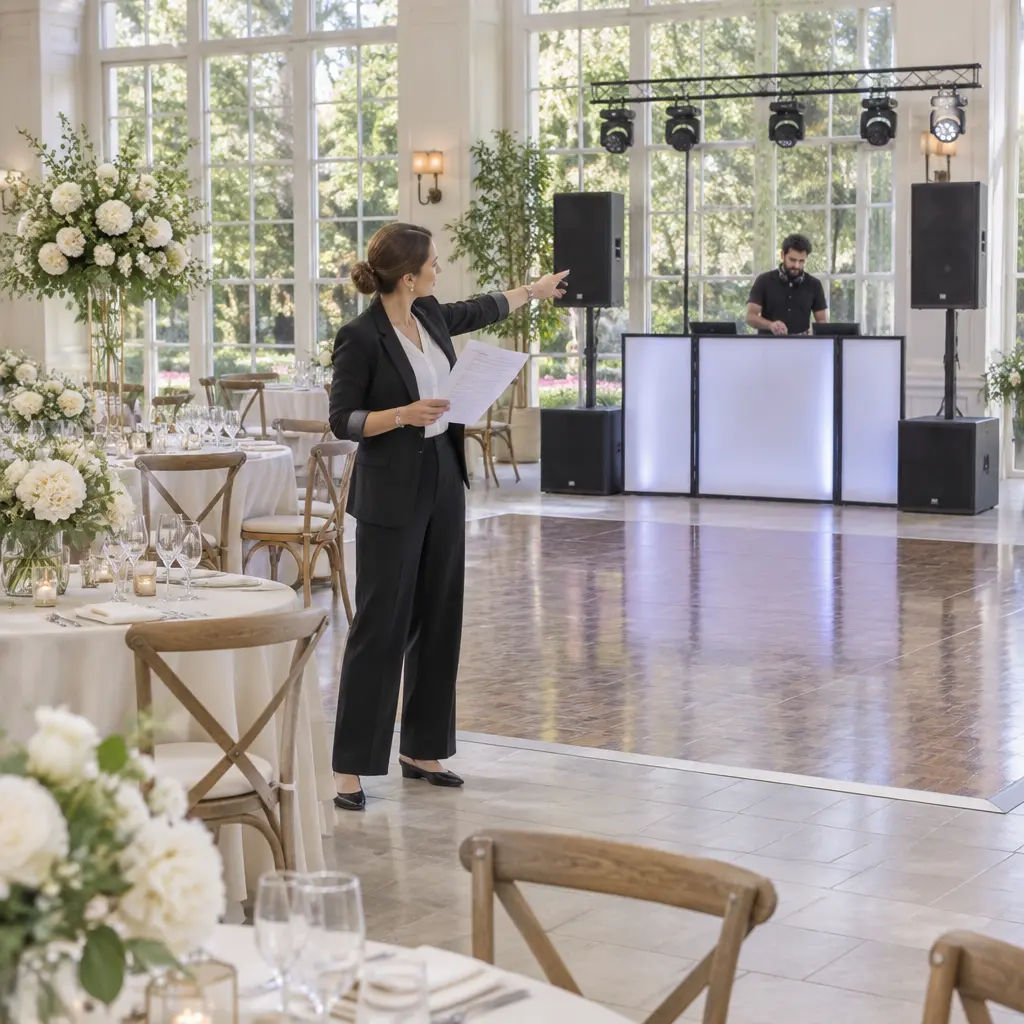
Mobile DJ load-in efficiency is the ability to move, position, connect, and test sound and lighting equipment within the time a venue allows, without compromising safety or performance. Tight-turnaround success depends less on rushing than on removing uncertainty: confirm venue access and power in advance, pack for a planned setup sequence, assign clear roles, and use a repeatable sound-check checklist. These practices matter when one event must clear before another can enter; the U.S. Bureau of Labor Statistics reports that meeting, convention, and event planners often work under deadlines and coordinate multiple service providers, illustrating the time-sensitive conditions common to event production.
Load-In Planning Defines Mobile DJ Efficiency
Load-in planning is the advance coordination of people, equipment, routes, venue requirements, and task order so a DJ can reach operational readiness within a fixed window. In event operations, planning is not simply making a packing list: it connects the venue’s access rules to the physical sequence of unloading, assembly, cabling, testing, and handoff. The Event Safety Alliance’s safety guidance emphasizes advance planning, communication, and hazard control as core event-management practices.
For mobile DJs, the relevant subtypes include pre-event reconnaissance, equipment and case planning, crew-role assignment, and contingency planning. A practical measure is “ready-to-play time,” counted from the permitted start of access until music can be played at a tested, agreed level. Record that interval after each booking; comparing similar venues gives a more useful target than adopting a universal setup-time estimate.
Venue Reconnaissance and Access Confirmation
Venue reconnaissance means collecting the information that determines whether equipment can travel from vehicle to performance position safely and on time. Confirm the loading entrance, parking or unloading allowance, stairs and lifts, distance to the booth, room access time, furniture restrictions, and the person authorized to admit the crew. Ask for written confirmation of the setup deadline and when the room must be clear for guests or another supplier.
Electrical and production details belong in the same conversation. Request the locations and type of outlets, whether circuits are shared, the venue’s rules for cable covers and tape, and any sound-level limits. The U.S. Occupational Safety and Health Administration advises employers to keep walking-working surfaces free of hazards; that principle makes route checks and secured cables operational necessities, not cosmetic finishing touches.
Run-of-Show and Time Buffers
A run-of-show is the event’s timed sequence of activities, including vendor access, room turnover, doors, announcements, and performance cues. Build the DJ setup backward from the first required audio cue, then identify the latest safe start for unloading. Include a buffer for predictable friction such as a delayed keyholder, a blocked service corridor, or a lift shared with caterers.
Do not treat every minute as available setup time. The venue may require the room to remain clear during cleaning or décor installation, and other vendors may have priority in narrow access areas. A simple schedule can show planned arrival, access confirmation, equipment placement, connection and testing, and a final safety walk. If the buffer disappears, use a pre-agreed reduced setup rather than improvising unsafe shortcuts.
Equipment Design Speeds Mobile DJ Load-In
Equipment design for efficient load-in is the selection and organization of a reliable rig around the venue, event, and available crew. The best setup is not necessarily the smallest or most elaborate; it is the one that meets the brief while reducing case count, connection complexity, and failure points. Common approaches include a compact all-in-one system, a modular component rig, and a hybrid setup with a simplified backup path.
Standardized Cases and Setup Order
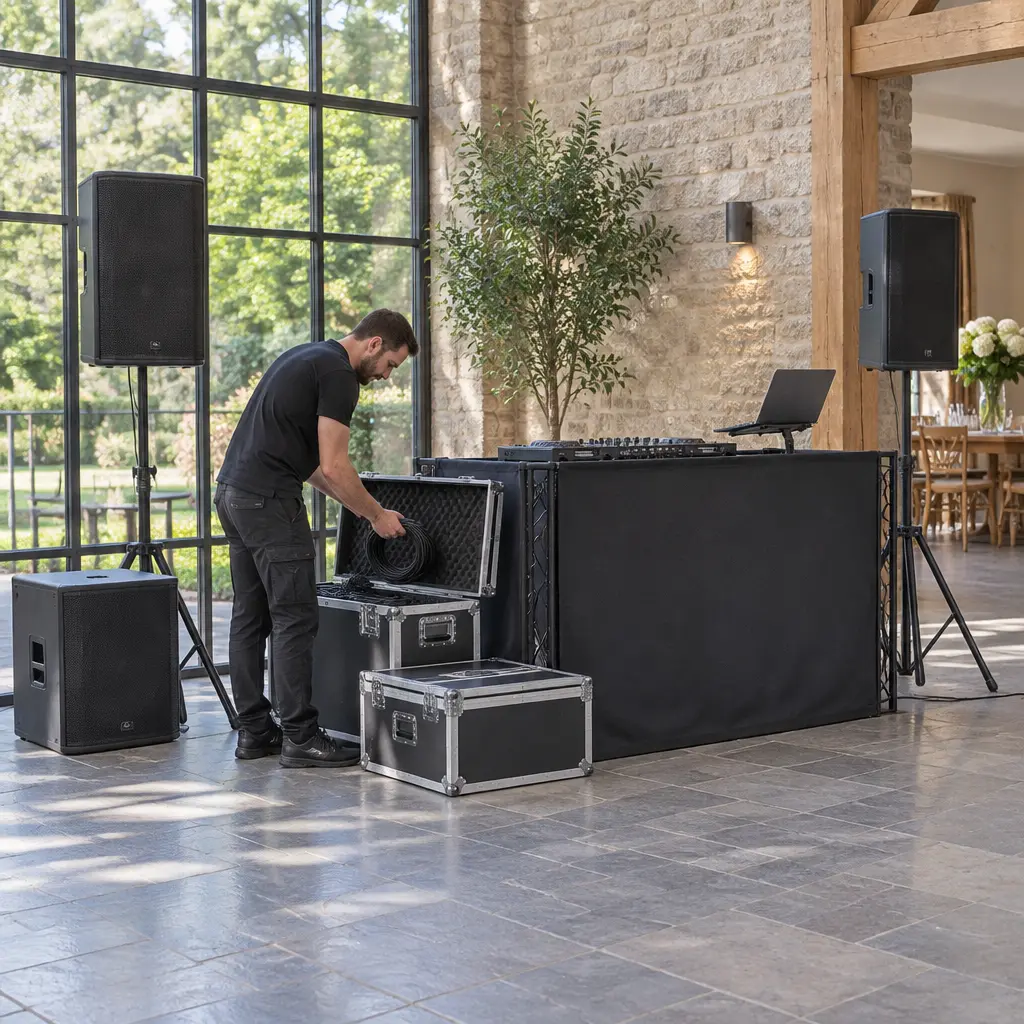
Standardized cases group equipment by function and make the unpacking sequence predictable. Label cases clearly—such as audio, lighting, stands, cables, and backup—and pack items in the order they will be used. Keep frequently needed connectors and adapters accessible, but protect them from loss with a dedicated, inventoried pouch.
A useful sequence is to place the booth and speaker positions first, establish power and signal paths, connect the playback system, and then add optional lighting. This prevents a common inefficiency: unpacking every case before confirming that the booth can occupy its planned location. Rehearse the sequence at the home base and revise it when equipment or crew changes.
Modular Rigs and Deliberate Redundancy
A modular rig separates essential functions—playback, mixing, sound reinforcement, and lighting—so the DJ can scale the setup to the room. A small ceremony may require a compact speaker and microphone, while a larger reception may call for additional coverage. Modular equipment helps prevent unnecessary handling, but only if each configuration has a documented wiring plan.
Redundancy means carrying a backup for critical functions without duplicating the entire system. Prioritize items whose failure would stop the event, such as a playback device, essential cables, power adapters, and a microphone when announcements are required. The Federal Emergency Management Agency’s continuity-planning approach—identify essential functions and prepare alternatives—offers a useful general model, although a DJ should tailor backups to the event’s actual risks and venue rules.
Crew Coordination Improves Turnaround
Crew coordination is the assignment and communication of tasks so several people can move equipment and complete setup without blocking or duplicating one another. Its main forms are solo workflows, two-person load-ins, and coordinated multi-vendor access. More people do not automatically mean faster setup: the route, available space, and defined responsibilities determine whether extra hands help.
Role Assignment and Communication
For a two-person crew, assign one person to oversee the route, venue contact, and equipment placement while the other stages cases and assembles the system. Agree on who confirms power, who handles audio connections, and who performs the final test. Use short, closed-loop confirmations for important instructions—for example, repeat the agreed speaker location before stands are opened.
When several vendors share a loading area, designate a single point of contact to coordinate arrival and resolve conflicts. The Event Safety Alliance’s guidance on communication and coordination supports this approach: clear responsibility reduces confusion around access, hazards, and changes. Keep a phone-based contact list and a printed or offline version in case reception is poor.
Safe Handling and Clear Routes
Safe handling means moving cases and stands in ways that reduce strain, tipping, collisions, and trip hazards. Use cases with appropriate handles and wheels, avoid carrying loads that obstruct vision, and ask for help with awkward or heavy equipment. OSHA’s general ergonomics guidance recommends reducing hazardous lifting demands through work design and mechanical assistance where practical; carts and planned routes apply that principle to event load-ins.
Keep corridors and exits clear, secure cables that cross walking paths, and do not leave cases where guests or venue staff will pass. The National Fire Protection Association’s life-safety framework treats unobstructed means of egress as essential. If the planned route is blocked, stop and coordinate an alternative instead of threading equipment through an unsafe crowd.
Setup Sequencing and Sound Checks Protect Readiness
Setup sequencing is the order in which the DJ positions, connects, and tests equipment. A sound check verifies that playback, microphones, speakers, and required inputs function at appropriate levels before guests arrive. Together, these practices turn a rushed arrival into a controlled process and help distinguish a genuine equipment fault from a connection or configuration error.
A Repeatable Connection and Test Sequence
Use a written checklist tailored to the rig: confirm the booth position; inspect power and cable routes; connect sources and mixer; connect speakers; power equipment in the manufacturer-recommended order; test left and right channels; check microphones; and verify the agreed operating level. Follow manufacturer instructions for power, ventilation, and handling rather than assuming all devices behave alike.
The National Institute for Occupational Safety and Health identifies hazardous noise exposure as a workplace risk and recommends controls to reduce exposure. For DJs, that is a reason to avoid unnecessarily loud testing and to follow venue sound limits, not to rely on a single universal decibel threshold. Where a venue specifies a limit, use an appropriate meter and confirm how and where it is measured.
Cable Management and Power Checks
Cable management is the routing, securing, and labeling of electrical and audio leads so connections remain identifiable and pathways stay safe. Separate power and signal runs where practical, avoid stretched or pinched cables, and use venue-approved covers or securement methods where a route crosses foot traffic. Label both ends of critical leads to shorten troubleshooting.
Check that the available supply matches equipment requirements and that plugs and cables show no visible damage. Do not defeat grounding or overload outlets to save time. If power access is uncertain, contact the venue or a qualified electrician; do not improvise electrical distribution beyond your competence or the venue’s authorization.
Contingency Planning Handles Delays and Venue Changes
Contingency planning is the preparation of safe, workable alternatives for likely disruptions, including late access, a changed room layout, equipment failure, or a missing power source. It does not mean carrying every conceivable item. It means identifying which event functions are essential, what could prevent them, and what fallback is realistic within the time and venue constraints.
Reduced-Setup Options
A reduced setup is a preplanned configuration that preserves essential service while omitting nonessential production. For example, the DJ may prioritize playback, one microphone, and the required speaker coverage before adding decorative lighting. Agree on this priority order with the client and venue in advance so a late start does not trigger a disagreement about what can be dropped.
Keep the reduced configuration documented, including its cases, cables, and power needs. A smaller setup is not automatically safer if it is assembled hurriedly or leaves inadequate sound coverage. Test the fallback at least once before relying on it at a live event.
Learning from Each Turnaround
A post-event review converts experience into better logistics. Record actual access time, time to ready-to-play, unexpected obstacles, missing items, and any safety concerns. Separate causes the DJ can control—such as confusing case labels—from constraints that require venue coordination, such as a delayed room release.
A simple comparison chart can track planned versus actual setup time across venue types, crew sizes, and rig configurations. Do not treat the numbers as universal benchmarks: stairs, distance, room layout, and access rules differ. Use the data to improve estimates and identify recurring bottlenecks, then confirm each new booking’s conditions rather than assuming a familiar venue will operate the same way.
Conclusion: Make Turnarounds Predictable, Not Hectic
Efficient mobile DJ load-in begins with venue reconnaissance and a realistic run-of-show, continues through standardized equipment, clear crew roles, and safe setup sequencing, and is protected by sound checks and practical contingencies. Tracking ready-to-play time and reviewing each event helps replace guesswork with venue-specific evidence. Before the next booking, confirm access, map the route, label the cases, assign responsibilities, and agree on a reduced setup. These small steps protect both event quality and crew safety when the venue clock is tight.
Sources: U.S. Bureau of Labor Statistics, Occupational Outlook Handbook: Meeting, Convention, and Event Planners, https://www.bls.gov/ooh/business-and-financial/meeting-convention-and-event-planners.htm; Event Safety Alliance, The Event Safety Guide, https://eventsafetyalliance.org/esa-event-safety-guide; Occupational Safety and Health Administration, Walking-Working Surfaces and Personal Protective Equipment, https://www.osha.gov/walking-working-surfaces; Federal Emergency Management Agency, Continuity Guidance Circular, https://www.fema.gov/emergency-managers/national-preparedness/continuity; Occupational Safety and Health Administration, Ergonomics, https://www.osha.gov/ergonomics; National Fire Protection Association, NFPA 101: Life Safety Code, https://www.nfpa.org/codes-and-standards/nfpa-101-standard-development/101; National Institute for Occupational Safety and Health, Noise and Occupational Hearing Loss, https://www.cdc.gov/niosh/noise/.